
At Firefinch Software, our developers work with instrument manufacturers of all sizes – from new startups to large multinationals. Whatever the manufacturer’s size and experience, understanding the needs of the customer is key. For biotech instrumentation manufacturers, this means understanding the compliance needs of your users and building the relevant audit capabilities into your software. Getting this right will increase trust in your company and give your customers the confidence needed to invest in your instrument.
The market values compliance
The biotech instrumentation market is huge with large industries such as pharma, food and cosmetics driving a need for reliable instruments to ensure safe and consistent manufacture of regulated products (Good Manufacturing Practice; GMP). A much smaller portion of the market is R&D instrumentation, where adaptability is often favoured over compliance.
Instrument manufacturers will make a strategic decision about which market they want to enter. The decisions an instrument manufacturer makes early in development of their instrument can have wide reaching consequences on market access further down the line. Many manufacturers prioritise beautiful, functional software but underestimate the compliance infrastructure underneath it. Fundamentally getting the software right reduces risk for your customers.
The regulatory landscape
There are two crucial pieces of legislation that underpin how software should be used and developed for GMP instrumentation. FDA 21 CFR applies in the USA and EudraLex Annex 11 applies in the EEA. These regulations define several requirements for the software including record generation, security controls, audit trails and user authentication. In addition, 21 CFR Part 820 has requirements for a Quality Management System (QMS).
| Document | Document type | Jurisdiction | Remit |
|---|---|---|---|
| 21 CFR Part 11 | Regulation | USA | Electronic signatures for GMP |
| 21 CFR 820 | Regulation | USA | Quality Management |
| EudraLex Volume 4 Annex 11 | Regulation | EEA | Computerised systems for GMP |
| GAMP 5 | Guidance | International | Computerised systems for GxP |
| ISO 9001 | Standard | International | Quality Management Systems |
| USP 1058 | Guidance | International | Analytical Instrument Qualification |
| ICH Q2(R2) | Guidance | International | Validation of analytical procedures |
| ISO 14001 | Standard | International | Environmental management |
| ISO 31000 | Standard | International | Risk management |
| ISO/IEC 27001 | Standard | International | Information security, cybersecurity and privacy protection |
| ANSI/CAN/UL 2900-1 | Standard | USA | Cybersecurity |
| ISA/IEC 62443 | Standard | International | Automation and Control Systems Cybersecurity |
Regulations applicable to GMP customers that good software will support.
Note: software itself cannot be “compliant” – compliance depends on correct installation, intended use, and the surrounding processes. Software can help (or hinder) compliance.
What do GMP labs actually need from your software?
If your customers are likely to be audited by the FDA, MHRA or EU, it is important that you understand what the regulators will be looking for and how your instrument can support your customer through the audit. You will need to have a Quality Management System in use to ensure that all documentation relating to the instrument is up to date and aligned to ISO 9001.
The report your instrument produces is the real product, not the instrument itself
This blog from Science Insights goes through the basics of a GMP audit and provides advice on how GMP labs will need to prepare. In terms of instrumentation software, it is important to understand that the software cannot just provide data capture, but also needs to support data traceability, user management, and audit-readiness. This is underlined through a few key requirements:
- Manuals and training materials. These help your customers write their own SOPs and qualify their operators, and may need to be available in several languages depending on the jurisdictions they operate in.
- Validated performance. Evidence backed claims on the accuracy, reproducibility, working range, sensitivity etc. of the instrument. Procurement is underpinned by design qualification (see below) where the product must be aligned with its intended use. Publishing your product’s performance makes this possible for your customers.
- Risk management. An instrument built to ISO 9001 will reassure GMP customers that you have followed a risk-based approach to product design. Identifying and mitigating risks during product design and development can be achieved with tools such as Failure Mode and Effects Analysis (FMEA) and applies at software, hardware and product levels.
- Cybersecurity. Vulnerabilities are a data integrity risk, and so security is a GMP concern as well as a broader IT one. Concerns such as ensuring secure connectivity to LIMS and ELNs, a well defined patching and vulnerability management plan, role-based permissions based on secure access control measures, and tamper-resistant audit trails must be addressed.
- GDocP. Good Document Practices require data traceability and integrity along ALCOA principles (see below). Data should be attributed to users through electronic signatures (21 CFR Part 11).
- Instrument qualifications. Demonstrate the correct installation and operation of the instrument through its operational lifetime. More detail on this below.
Displaying the results of an analysis is not enough. The gap many manufacturers miss is in the traceability around SOPs, consumables, reagents, and operating conditions.
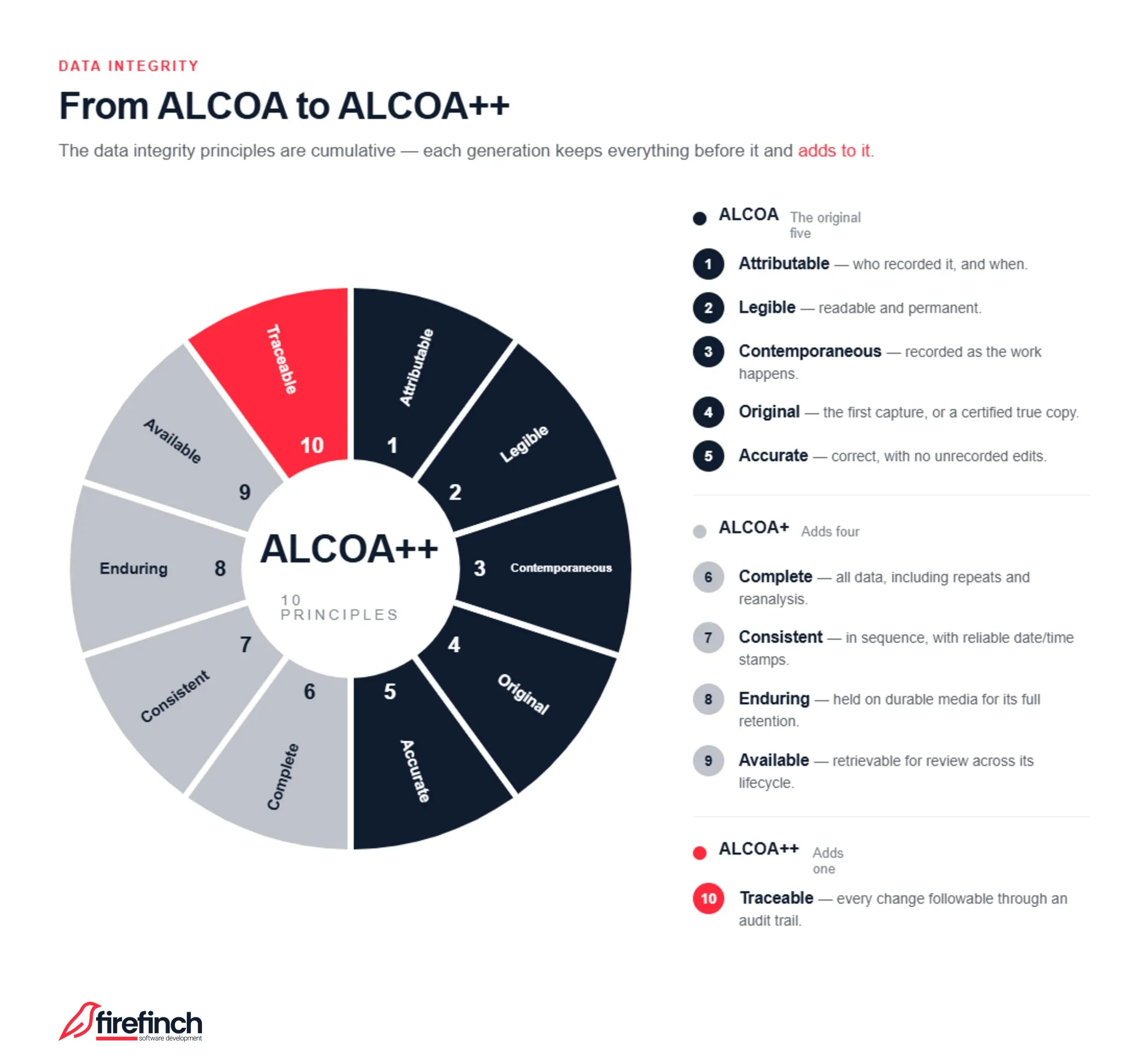
ALCOA for data integrity. ALCOA is a core principle of GDocP. The acronym originally stood for Attributable, Legible, Contemporaneous, Original, and Accurate and was used as a set of data integrity principles in the pharmaceutical and other industries. The term has more recently been updated (ALCOA+ and ALCOA++) to include Complete, Consistent, Enduring, Available and Traceable to account for recent advances in automation, cloud-based environments and electronic records.
Common software mistakes in GMP instrumentation
In our experience, there are a few common mistakes that instrument manufacturers make. These can be easily avoided if they are considered during instrument development.
- Not designing for traceability from the start. Traceability and record keeping are a core tenet of cGMP. This matters for software both internally in design (i.e. baking strong data integrity and traceability controls into the software design and architecture) but also in thinking about how the product will fit into a wider traceable environment (e.g. support for barcode scanning, controls around authentication, typical user roles, etc.). All of these are difficult to put into the software late in the development process.
- Not considering data accessibility and interoperability: Think about both interoperability requirements (i.e. LIMS integration, automation standards etc.) that are relevant for your product. But also long term accessibility of the data cGMP mandates that data should be legible and accessible for long periods after manufacture (for some biologics, up to 10 years after manufacture) so support for open or industry standard file formats is vital.
- Treating reporting as an afterthought. Often a weak point, an exported report is often the real product generated by the software. Care should be taken to ensure that reporting is neither infinitely configurable nor extremely rigid. If a customer has to transcribe the reported results into Excel to perform simple operations like mean or standard deviation for example this is a poor outcome.
- Ignoring localisation. If you plan for global deployment of your instrument build software localisation into the interfaces as the software is built.
- Not having an appropriate Software Development Life Cycle (SDLC): The downstream requirement for software to have undergone validation and verification places obligations on the development of the software. Proper traceability of requirements, demonstrable testing, etc. all of which is difficult to do after the fact. A documented SDLC capturing this as part of normal development process is required.
How software can support qualification of the instrument
Once your instrument is on the market, each installation will need to be qualified to prove to regulators (and users) that the instrument is operating correctly. As a manufacturer, it is a good idea to provide the documentation and software tooling that makes qualification straightforward for buyers.
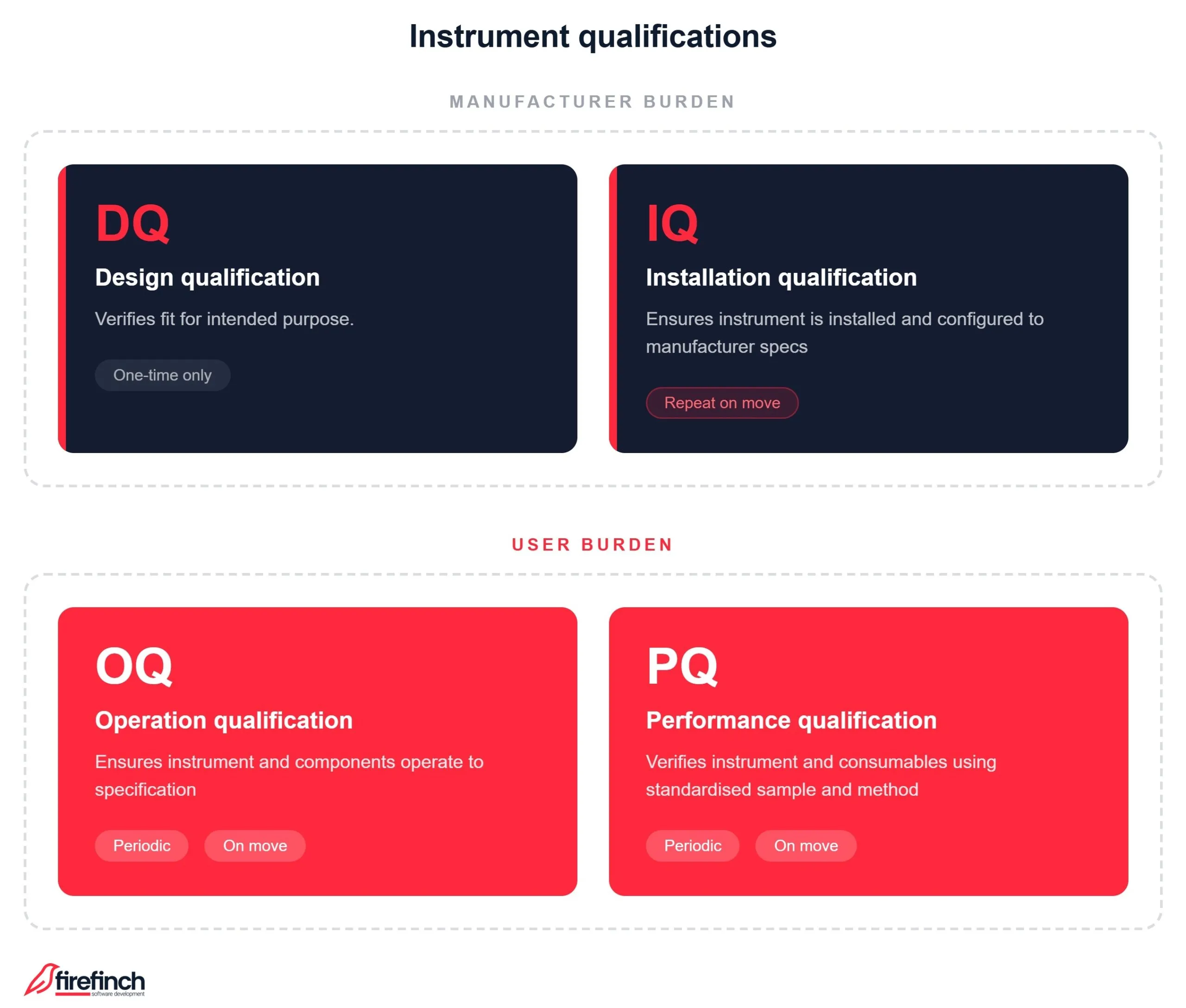
Design qualification (DQ) is performed by the customer to verify that the product is fit for intended use. They can do this if the instrument has published specifications. Installation Qualification (IQ) documents that the instrument has been correctly installed and configured to the manufacturer’s specifications. The software can support IQ by providing checks for correct initial installation and reminders to perform checks should the instrument be moved or serviced.
Operation Qualification (OQ) and Performance Qualification (PQ) verifies that the instrument is operating correctly and that protocols are being followed using the correct consumables and methods. Operation qualification also covers software specifically in terms of software functions, secure data storage, backup, and archiving and software configuration and/or customization (see USP 1058).
GMP facilities must have equipment qualified before use. Reducing friction for your users by providing support as part of your instrument software will therefore be a big win when you are competing with instruments that don’t.
For an instrument manufacturer, the implication is clear: instruments that make qualification difficult will lose deals to those that make it easy
Cybersecurity in GMP instruments
GMP facilities are high-value targets for malevolent actors that might want to disrupt operations or hold data to ransom. Downtime is expensive and facilities will hold a lot of sensitive IP. If the integrity of GMP records can’t be assured, the data behind every batch those records support is called into question.
Common vulnerabilities and poor practices in existing instrument software that manufacturers must address include:
- Unauthenticated or unencrypted connections. Integrations with LIMS, ELNs, ERPs or cloud services that lack mutual authentication or encryption.
- Default or hardcoded credentials. Shipping instruments with shared default passwords.
- Shared accounts and weak access control. Generic logins without role-based permissions, which make it impossible for customers to attribute actions to individuals or maintain a meaningful audit trail.
- No patching or update route. Without a mechanism to deliver security updates, vulnerabilities accumulate over the instrument’s life.
- Overly broad attack surface. Unnecessary open ports and services, exposed USB ports, unrestricted removable media and end-of-life operating systems all widen the attack surface.
- Insecure data storage and audit logs. Unencrypted local databases, log files or backups, along with audit trails that can be silently edited or deleted, undermine both confidentiality and data integrity.
If you include AI/ML in your software (e.g. for data interpretation) then there are additional compliance risks such as training data bias, model drift, adversarial inputs, non-determinism, and explainability under audit. If your customer gets audited and can’t explain why the instrument produced a result, it’s a serious liability. Building explainability, drift detection, and documented validation of ML models into the software documentation will mitigate these risks for your customer.
Understanding the vulnerabilities in your software is a key part of frameworks such as IEC 62443, the international series for industrial automation and control system security. Vulnerability detection and mitigation is a key part of your QMS documentation and must be considered and mitigations built in as the software is built – not added on at the end.
Conclusion: Compliance is a commercial advantage, not a burden
Making your instrument GMP-ready makes a lot of sense. Software that takes into account clients’ compliance needs unlocks larger customers, reduces customer barriers and provides premium positioning. The cost of getting this wrong is clear: deal will be lost to competitors who have the paperwork, not just the features.
The good news is that with the frameworks in place, building the required data trails is entirely achievable. The key is to start early and build compliance-ready features into the instrument from the outset.
💬 If you would like to discuss software development for your instrument then reach out to our team.
🖱️Firefinch specialises in compliant life science instrumentation and medical device software development with deep expertise in regulatory requirements, quality systems, and development best practices. Reach out to Isabel to learn more.